I first learned of Martin Luther King Jr. on a recommended reading list from the other side of the world, years before I learned about his significance within the U.S. In Korea, he was a biography assigned from a , a speech introduced in English class and a distant figure described in historical pages.
Years later, as a postdoctoral researcher at Johns Hopkins, I learned that his legacy is not treated as closed history here in the U.S. It is practiced. One day, an Inside Hopkins newsletter landed in my inbox with a list of MLK Day events, including a Day of Service. It introduced local organizations where JH students and staff could volunteer — an invitation to honor Dr. King’s legacy through service, reflection and community connection. When I started my postdoc, my world narrowed to research, with days crowded with experiments and analyses. In a new country, volunteering does not come naturally. It can be hard to know where help is needed, which places are safe and whether you belong in the work at all.
Still, the email offered something simple: a chance to participate in the community as part of Johns Hopkins, not only as a researcher. I found myself thinking, “Why don’t I give it a try?”
That is how I connected with the Bea Gaddy Family Center, a community-based nonprofit that provides food and essential items to neighbors across the Greater Baltimore area and throughout Maryland, only a short walk from the Johns Hopkins East Baltimore campus. Founded in 1981, the organization has served the community for more than 45 years. It carries the legacy of Dr. Bea Gaddy, who began this work and insisted on a principle that can be easy to forget in systems designed for efficiency: People may arrive without food, clothing or money, but they still arrive with dignity.
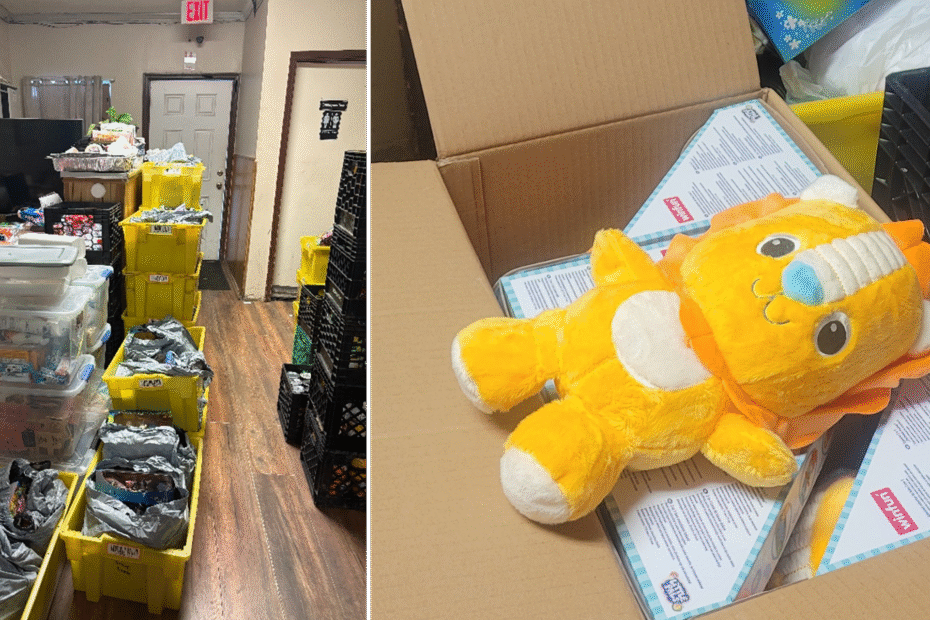
On the day of service, our task was straightforward. We sorted donated canned goods and nonperishable items, and assembled bags for families who would need them that day. The work was practical and repetitive: drinks, beans, vegetables, soup, protein, pasta or rice, snacks and basic household supplies, portioned carefully with nutrition and balance in mind. In a limited space, a small group of people — many from departments that rarely interact — learned to move in rhythm: lifting, organizing, carrying, refilling, checking counts.
What surprised me most was the attention to detail beyond food. There were diapers and hygiene products, children’s clothing and other essentials that are often missing from public conversations about “hunger.” And then there were the toys.
They were not leftovers or broken hand-me-downs. They were new, soft, high-quality stuffed animals — so good that even I wanted to pick one up and play with it. Placing a toy into a bag felt different from placing a can of soup. Food helps a body get through the week. A toy speaks to something less measurable: comfort, imagination and the message that a child’s life is worth care, not only survival.
In that moment, I understood the work of the center in a new way. This was not only about distributing calories. It was about protecting dignity and, in a quiet sense, tending the future.
As we finished, I thanked Sandra, one of the Bea Gaddy staff members who helped lead the day, for what it takes to keep a center like this running. She responded with a sentence that stayed with me: “I’m not just helping others — I’m helping me, too.” The sentence brought back a memory I had not revisited in a while: volunteering in Cambodia as part of the Korean Medicine Service Team Abroad (KOMSTA). Some patients traveled more than two hours by bus to receive treatment. Their effort reframed my own work at the time and reminded me how much meaning can live inside routines that sometimes feel repetitive or exhausting in daily practice.
That day in Baltimore, I realized the same lesson wasn’t limited to clinical work abroad — it could also reshape how I live my life in the lab, alongside colleagues from across Johns Hopkins whom I might never have met in the lab. Thanks to Martin Luther King Jr. Day of Service opportunities, I gained a renewed sense that service and science do not compete. They can strengthen each other.
MLK Day, I realized, is not only a memorial. It is an invitation — to show up, to learn where dignity lives and to widen the boundaries of what we consider “our work.”
Related Content
- Stories That Weigh, Communities That Uplift
- Supporting Afghan Refugees in Baltimore
- Popping the Johns Hopkins Bubble
Want to read more from the Johns Hopkins School of Medicine? Subscribe to the Biomedical Odyssey blog and receive new posts directly in your inbox.