On a few occasions, I’ve heard the refrain that doctors make the “worst” patients. This can mean a few different things. This claim may refer to the way some physicians view their own medical appointments as educational opportunities, going out of their way to lecture and quiz students and residents on the team. In other cases, it may mean that physicians are particularly demanding, asking for detailed justifications for treatment decisions. Most of the time, however, doctors are referred to as “bad” patients because they put their work above their health, insisting on exerting themselves professionally, as they neglect to follow their colleagues’ advice.
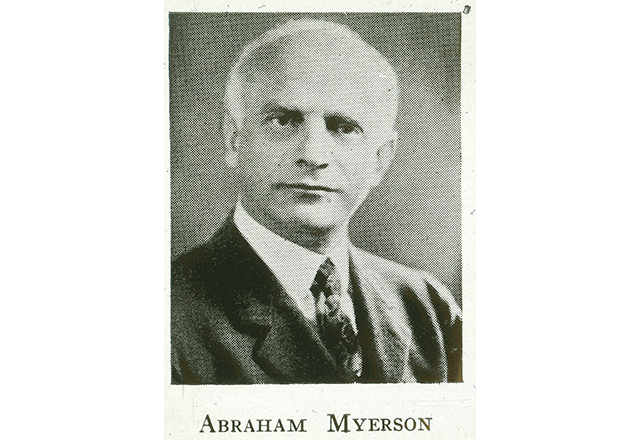
Instead, an unexpected piece of literature I came across in the archives caught me off guard as it led me to consider how doctors behave (and perform) as patients. Dr. Abraham Myerson emerged from humble beginnings to eventually become a Harvard professor in psychiatry, after scraping together money for medical school through various odd jobs. Naturally, Myerson’s varied research interests centered on mental illness, but in an article published posthumously in The Atlantic in 1952, he described in great detail his personal experience with heart disease, which was the eventual cause of his death at 66.
Myerson’s illustration of his illness experience was that of a meticulous, dutiful and rosy patient. There is indeed one moment in which he falls into the “doctor as bad patient” archetype, as he wrote: “I think I can safely say that the physicians who studied me knew that there was one thing I would not accept from them, and that was a mandate that I retire from activity.” However, with the exception of the six years Myerson continued working against medical advice, he appeared to be an absolute model patient.
Myerson catalogues his symptoms with an unbelievable degree of precision and detail. He described his very first symptom, a noise in his head, as “a hissing sound, but shortly there was added to this a rhythmic hiss synchronous with the heartbeat.” He noticed aggravating circumstances, as for example: “If I exerted myself physically beyond a reasonable limit, there would be some feeling of tension and pain along the left border of the heart, which I assumed to be due to ventricular strain,” thereby even adding his own diagnostic interpretations. He seemingly effortlessly made major adjustments to his lifestyle, as in 1947 when he adopted a “salt-free acid-ash diet” after an episode of shortness of breath upon falling asleep. He was well aware of his medications and their doses, as he described “getting along well on a daily quota of digitalis, a weekly injection of mercuhydrin…”
Despite being keenly aware of the severity of his condition, Myerson displayed a seemingly ideal combination of optimism and discipline. Following the kind of approach he had apparently prescribed to anxious patients, he forced himself to confront a fear of dying in his house alone. Despite shaking hands, a pounding heart and an episode of vomiting, the determined Myerson refrained from sleeping at a relative’s house and managed to rid himself of this fear after one night. Myerson also wrote that, “on the whole, it has been easy for [him] to maintain cheerfulness and continue to work.” With himself as a research subject, Myerson concluded that this was evidence that “we can only really endure life if we cherish healthy illusions…” Rather than dwelling in despair, Myerson not only overcame any negative emotions he experienced, but even leveraged his final days on Earth to continue contributing to the advancement of his field.
Reading Myerson’s account, I wondered what purpose it had served for him. I cannot say whether he had planned all along to publish his notes in a popular magazine like The Atlantic. But if he had, I wonder to what extent he was consciously performing what a patient should be like for a wide audience. Myerson demonstrates a keen sense of what is happening in his body, why, and when. He also does what he can to slow his disease, but is unperturbed about whether treatments will work. Any sign of ill health or angst is an opportunity to take concerted action to address the matter in a logical, precise fashion. As Myerson acted out and recorded this routine of his, I wonder if he thought of the example he might set for the patients who had frustrated and baffled him throughout his life.
Perhaps Myerson had no intention of publishing his experience. In this case, maybe treating his own illness as a case study like any other allowed him to establish emotional distance. Perhaps the ability to meticulously record the goings-on of his body gave him a sense of control over a process that deep down he knew was an inevitable march toward the end. Or, perhaps complaining about “bad” patients had made being imperfectly human feel hypocritical.
As an inveterate hypochondriac, I wondered as I progressed through my training whether I, too, would reach such a level of emotional regulation. After all, the colloquial name for my condition is “medical student syndrome,” whereby inexperienced students fool themselves that they are afflicted with illnesses they learn about. This implies that graduation is the cure for this infirmity. I simultaneously wondered whether Myerson’s remove was truly desirable. Was he prohibiting himself from experiencing an expected degree of existential dread and fear? Is that healthy? Was his account even true?
I’m afraid Myerson’s other materials provided me with few answers to these questions. But this document was a reminder that one day I, like every other physician in training, will inevitably have my own encounter with mortality. Equally inevitably, my own profession and patients will have a hand in shaping how I experience it. Whether my account of my final days resembles Myerson’s or the “worst patient,” is anyone’s guess.
Related content
- The Case for Studying History As a Medical Student
- Summer Reading from the Hopkins History of Medicine Department
Want to read more from the Johns Hopkins School of Medicine? Subscribe to the Biomedical Odyssey blog and receive new posts directly in your inbox.