
During an NCS, an electrical stimulator delivers mild electrical signals to stimulate motor and sensory nerves. The stimulation generates action potentials, which are changes in voltage in the cell membrane, that are recorded (Grider, et al., 2023) (Haustein & Swartz, 2015). During an EMG, a thin needle with an electrode at the tip measures electrical signals generated from relaxed and contracting muscle fibers from different muscles. These electrical signals appear as sounds and waveforms on the screen (Menkes & Pierce, 2019). Taken together, the results of these two studies are analyzed and written in a report to determine factors such as the type, duration and location of injuries, if they are present.
Physicians who perform electrodiagnostic studies undergo residency training in physical medicine & rehabilitation (PM&R) or neurology on how to use NCS and EMG to diagnose neuromuscular diseases, which include nerve injuries (AANEM, 2024). The American Association of Neuromuscular & Electrodiagnostic Medicine (AANEM), a nonprofit membership association, has a position statement “Who Is Qualified To Practice Electrodiagnostic Medicine?” that recommends educational requirements to include a preceptorship of at least six months that includes a minimum of 200 performed electrodiagnostic tests, and an additional year of NCS/EMG experience after residency.
As a PM&R resident rotating in an NCS/EMG clinic, I have learned so much from my PM&R and neurology attendings, patients and co-residents on how to do and interpret these studies. Despite this, there is so much more to learn, whether studying EMG sounds described as “noise generated by a seashell held close to the ear,” “rain on a tin roof,” or “low-powered motorboat engine” (Dillingham, et al. 2021), or interpreting results and writing reports. I look forward to gaining more NCS/EMG experience in residency!
Image 1: One type of NCS/EMG machine used in clinic.
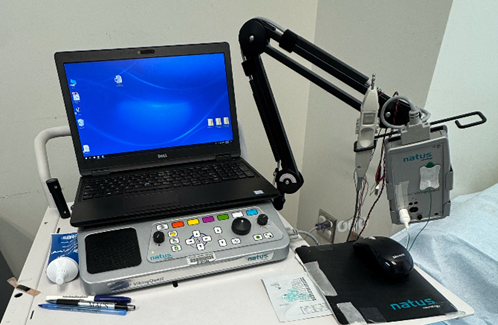
Image 2: Close-up of NCS/EMG machine used in clinic with EMG needle connected to the machine and electrical stimulator in the top left.
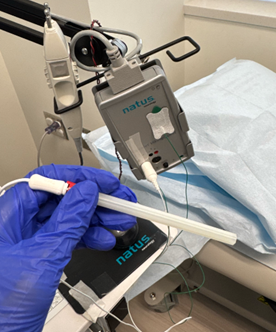
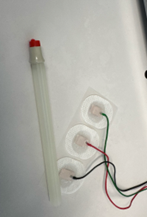
Image 3: Close-up of EMG needle (left in image) and NCS/EMG electrodes (right in image).
 Have you ever thought about how nerves transmit signals throughout your body ? Neurons are nerve cells that have cell bodies that control cell activity , dendrites that receive signals and axons that transmit signals. Multiple axons grouped together and surrounded by connective tissues create the nerves that communicate with the body and originate from different parts of the brain and spine (Ashley & Lui, 2019). Nerve injuries can occur after trauma, compression and medical conditions like high blood sugar in diabetes, resulting in numbness, tingling and/or weakness. Carpal tunnel syndrome is one example of a nerve in the wrist, the median nerve, being compressed. Depending on the type, extent and length of injury, nerves recover at different rates. For example, axons have the potential to regenerate around 1 mm / day (Grinsell & Keating, 2014). The nerve conduction study (NCS) and electromyography (EMG) test are two electrodiagnostic studies that evaluate the health of nerves and muscles.
More info on NCS / EMG from Johns Hopkins Medicine
References
- Ashley, Kevin, and Forshing Lui. "Physiology, nerve." (2019). https://www.ncbi.nlm.nih.gov/books/NBK551652/
- National Institute of Neurological Disorders & Stroke. Brain Basics: The Life and Death of a Neuron. Updated February 25, 2025. Accessed April 5, 2026. https://www.ninds.nih.gov/health-information/public-education/brain-basics/brain-basics-life-and-death-neuron
- Grinsell, D., & Keating, C. P. (2014). Peripheral nerve reconstruction after injury: a review of clinical and experimental therapies. BioMed research international, 2014, 698256. https://doi.org/10.1155/2014/698256
- Chaney, B., & Nadi, M. (2020). Axonotmesis. https://www.ncbi.nlm.nih.gov/books/NBK562304/
- Grider, M. H., Jessu, R., & Kabir, R. (2019). Physiology, action potential. https://www.ncbi.nlm.nih.gov/books/NBK538143/
- Haustein, D., & Swartz, (2015). C. Basic Electrodiagnostics for the Referring Physician. https://now.aapmr.org/the-electrodiagnostic-consultation-and-report/
- Menkes, D. L., & Pierce, R. (2019). Needle EMG muscle identification: A systematic approach to needle EMG examination. Clinical neurophysiology practice, 4, 199-211.
- American Association of Neuromuscular & Electrodiagnostic Medicine. (2024). Who Is Qualified To Practice Electrodiagnostic Medicine? https://www.aanem.org/docs/default-source/documents/aanem/advocacy/who-is-qualified-to-practice-edx-medicine.pdf?sfvrsn=892d519e_2
- American Board of Electrodiagnostic Medicine. Accessed March 27, 2026. https://www.aanem.org/abem/home
- Dillingham, T., Andary, M., & Dumitru, D. (2021). Electrodiagnostic medicine. In Braddom's Physical Medicine and Rehabilitation (pp. 115-152). Elsevier.