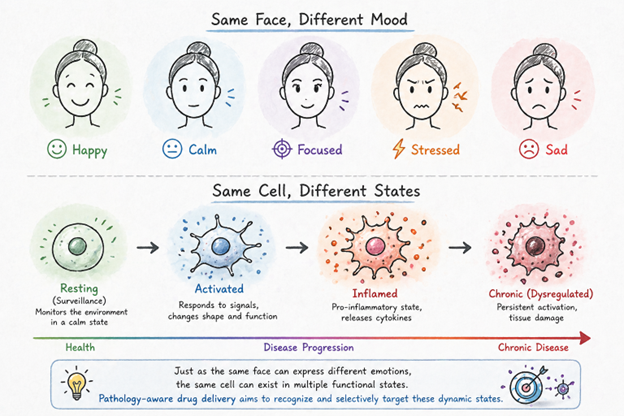
Targeted drug delivery has transformed modern therapeutics by enabling selective intervention at the level of specific cells and tissues. Much of this progress has been driven by receptor-based strategies, where overexpressed molecular markers guide therapeutic design. At the same time, it has become increasingly clear that receptor expression alone does not fully capture the complexity of disease biology.
Cells are not defined only by what they express, but by what they experience.
Receptor-based targeting assumes that diseased cells can be distinguished by stable molecular signatures. In reality, biology is far more dynamic. Cells exist in continuously evolving states shaped by their environment, function and stress.
In many diseases, neurons shift into hyperexcited, energy-demanding states, immune cells transition into inflammatory or dysregulated modes and cancer cells adapt metabolically to survive therapy. These changes are not fixed identities; they are transient, functional states that often escape traditional targeting strategies.
What if selectivity in therapeutics could emerge not only from molecular identity, but from biological context?
This question underlies an emerging framework: pathology-aware drug delivery.
Rather than relying exclusively on ligand-receptor interactions, pathology-aware systems are designed to sense and respond to the conditions that define disease. These include elevated metabolic demand, altered intracellular trafficking, oxidative and inflammatory stress, and changes in membrane dynamics and transport pathways.
In this view, disease is not simply a label attached to a cell, it is a state that reshapes how that cell interacts with its environment. Therapeutic systems that can recognize and exploit these shifts gain access to a new dimension of selectivity, one that is inherently tied to function, not just form.
Pathology-aware drug delivery reframes targeting as a multidimensional problem. Future therapeutic systems may integrate: (1) molecular targeting through receptor recognition, (2) state-dependent interactions driven by cellular activity and metabolism and, (3) microenvironmental responsiveness, including pH, redox state and inflammatory cues.
Such systems move toward a more adaptive model, one that engages with the full complexity of biological systems. Pathology-aware drug delivery is an extension that brings therapeutic design closer to the realities of biology. As the field continues to evolve, integrating molecular specificity with an understanding of cellular state and behavior will be critical for developing more effective and adaptable therapies.
The future of targeted therapeutics lies not only in recognizing cells, but in learning to read and respond to the states that define disease.
Author Perspective
This perspective is informed by a research trajectory focused on leveraging disease-associated cellular environments for targeted therapeutic design. My work has evolved from stimulus-responsive nanoparticle systems to hypoxia-responsive delivery platforms in tumor models, and more recently to nanomedicine strategies that selectively engage pathological cellular states in the central nervous system, including activated microglia and hyperexcited neurons. Collectively, these efforts have reinforced the importance of integrating cellular state and biological context as fundamental design principles for next-generation drug delivery systems.
Related Content
- The Molecule That Shaped Modern Biotherapeutics — A Story of Hope, and Science That Shaped Many Lives
- Learning About ICD-10 Codes
Want to read more from the Johns Hopkins School of Medicine? Subscribe to the Biomedical Odyssey blog and receive new posts directly in your inbox.