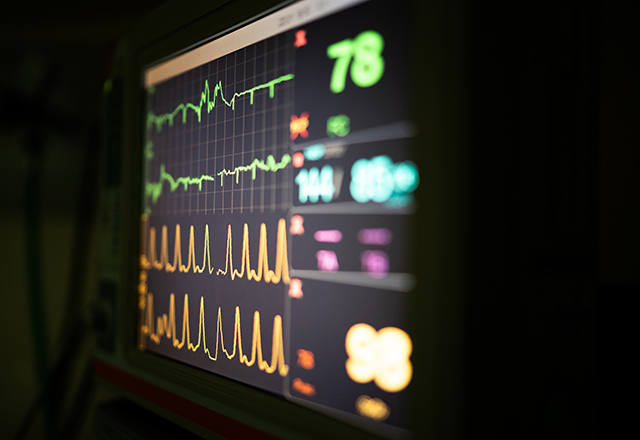
For many years, scholars from multiple disciplines have attempted to theorize how medical experiences are affected by sound. Composer Joel Beckerman describes hospital sounds as harmful by “making us sicker,” while anthropologist Tom Rice describes sound as a passive player in medicalized spaces, affecting patients by “reminding them that they are under surveillance and under the control of medical staff.”1,2 While theories differ and thought processes have evolved, sound has largely held a negative connotation in the medical environment, characterized as being disruptive to patients and providers alike.
My own first day in the intensive care unit felt like a distressing music lesson. My workstation was surrounded by alarms of conflicting rhythms, pitches and intensities, some sounding more unsettling than others. While attempting to budget my time within the frantic environment of the ICU, I needed to identify which “beeps” required an immediate response. After the first few hours of realizing that not all sounds were equal, I carefully listened from my workstation, trying to characterize which sonic qualities signaled a medical necessity.
These sounds were overwhelming for patients as well. Some patients attempting to sleep were startled awake by their IV pump alarm; others had family members in great concern over apnea alarms from ventilators. While I was navigating a goals-of-care discussion with a patient and their family, a brief moment of oxygen desaturation triggered a monitor alarm, adding a sense of panic and urgency to an already emotionally burdened conversation.
As my time in the ICU progressed, I began to contextualize what I was hearing — each pattern of alarms was organized into a category of action, and each action had a designated provider who took responsibility for that sound. The developing sonic framework provided my brain with enough comfort to cope with the overload of ICU stimuli, and my understanding of sonic language became more and more clear. There was a learning curve to appreciating sound in medicalized environments. To unfamiliar listeners, hospital sounds are often reduced to an anxiety-inducing cacophony, but when organized and defined, sound can provide valuable information and communicate information efficiently.
Then, I experienced my first code. The sounds no longer made sense; the framework didn’t quite work. All alarms were met with coordinated responses by multiple people — nurses, respiratory therapists, medical students, fellows — and me, performing CPR to a rhythm that was different from those I had grown accustomed to. Verbal orders were delivered over a multitude of alarms while conversations with the patient’s family occurred over the phone. Various lines of communication were ongoing among the members of the code team. After many cycles of CPR, the leader ended the code. Resuscitation was not achieved. Silence. No alarms, no beeping — the room was quiet.
It was the first time I noticed silence in the ICU. It felt eerie and unwelcome. Out of all of the sounds I had trained my brain to act on, silence was not one of them. As a provider, the silence initially felt like failure. But when the patient’s daughter arrived, the silence was interpreted differently: “At least he’s not suffering anymore,” she said.
Ethnomusicologist Ailsa Lipscombe perhaps best summarizes this experience, writing that “medical noise is inherently paradoxical. It produces conflicting epistemological and methodological resonances—a double life emphasizing both functionality and disturbance.”3
Today, hospitals aim for quiet environments to aid in sleep, recovery and prevention of delirium. The World Health Organization recommends all noise in hospitals to be less than 35 decibels — a level that, research shows, is regularly surpassed in intensive care units.4,5 While adjustments can certainly improve the current sound profile of hospitals, not all individuals interpret sound in a similar manner. Silence, to me, was disturbing, until it was redefined by a patient’s family. The raucous alarms that were once overwhelming were now, in a way, reassuring. If hospital sounds are presumed to be harmful to health, then the shared processing and recontextualization of those sounds — and their accompanied silence — must represent a beneficial adaptation of sorts, a type of psychologic and physical growth that is learned from new events. The “good” and “bad” of medical sounds become more nuanced, and their elicited responses become more complex. Despite ongoing attempts at hospital sound regulation, sound — like many other factors in medicine — will perhaps always exist as a uniquely perceived phenomenon that leads to vastly different patient and provider experiences.
Resources
- TedxTalks. (2015, June 16). Sonic Humanism: Transforming Global Healthcare [Video]. YouTube.
- Rice, Tom. 2013. Hearing and the Hospital. Canon Pyon, England: Sean Kingston Publishing.
- Lipscombe, A. (2024). When silence is heard: Embodied listening in medical facilities’ competing sonic epistemes. Ethnomusicology, 69(1)
- Berglund B, Lindvall T, Schwela DH. Guidelines for Community Noise. Geneva: World Health Organization; 1999
- Darbyshire JL, Young JD. An investigation of sound levels on intensive care units with reference to the WHO guidelines. Crit Care. 2013;17(5):R187. Published 2013 Sep 3.
Related content
Want to read more from the Johns Hopkins School of Medicine? Subscribe to the Biomedical Odyssey blog and receive new posts directly in your inbox.