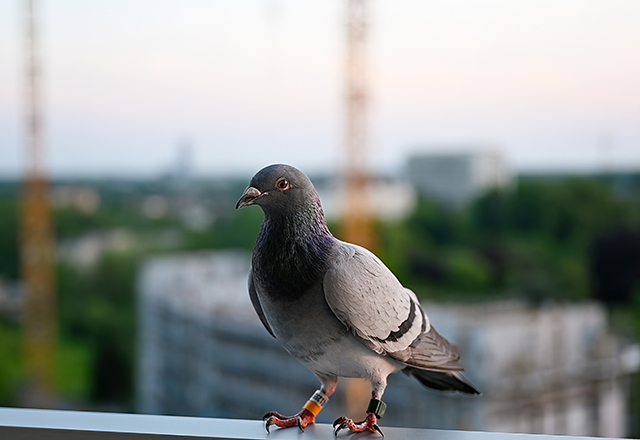
My father used to breed racing pigeons, a hobby known in Spanish as “colombofilia.” He had his own “palomar,” or pigeon loft, where he raised and trained these remarkable birds. Local clubs organized competitions in which pigeons were transported hundreds of kilometers from home and released together. Some of ours were taken from Guanajuato to Chihuahua, nearly 1,000 kilometers away, and a few managed to return home.
Because I helped raise the birds, I became deeply attached to them. We selected breeding pairs, watched the eggs hatch, cared for the chicks and trained them for competition. Over time, I learned to distinguish individual pigeons by their feather patterns, eye color, body shape and wing structure. Not all returned safely. Some arrived wounded after colliding with wires or cables, while others appeared to have been injured by hunters. My father treated them in an artisanal way, often applying gentian violet as an antiseptic. When a bird needed stitches, he called a man nicknamed “El Panadero,” who sutured its wounds.
What amazed me most was how such small animals could travel enormous distances and return to the same palomar. Pigeons are strong, resilient and intelligent, but the biological basis of their navigation remains debated.
Pigeons appear to combine several cues, including the sun, visual landmarks, atmospheric odors and Earth’s magnetic field. [1] One hypothesis proposed that iron oxide particles in the upper beak respond to the geomagnetic field and provide directional information. [1] In 2001, researchers reported 2–5-nm superparamagnetic magnetite nanocrystals forming 1–3-μm clusters in the upper-beak skin. Because these clusters were magnetically responsive and located near nervous tissue, the authors suggested that they might form part of a magnetic receptor. [2]
In 2004, pigeons were trained to distinguish the presence or absence of an artificial magnetic anomaly. Their performance was above chance, but declined when a magnet was attached near the cere, the upper beak was anesthetized or the ophthalmic branch of the trigeminal nerve was severed. These results suggested a magnetic-sensing pathway involving the upper beak and trigeminal nerve. [3]
A 2012 study later showed that the iron-rich beak cells varied greatly among pigeons, lacked neuronal markers, and expressed major histocompatibility complex class II. The authors concluded that they were macrophages rather than magnetosensitive neurons. [4]
In 2026, researchers identified superparamagnetic, iron-rich macrophages near hepatic nerve fibers. When these cells were temporarily depleted, pigeons released under overcast skies showed poorly directed flight and failed to return that day, yet they navigated successfully when the sun was visible. The authors proposed that liver macrophages might collectively detect geomagnetic direction and relay information to the brain through nearby autonomic nerves, although this mechanism has not been directly demonstrated.[1]
The pigeons from my father’s palomar may have returned by integrating sunlight, odors, landmarks and subtle magnetic signals. Their journeys were extraordinary feats of endurance and examples of animal navigation that science is still trying to understand.
References
- Lisowski C, Quetting M, Klaus D, et al. Homing pigeon navigation relies on superparamagnetic macrophages under overcast conditions. Science. 2026;392(6801):985–991. doi:10.1126/science.ady2486.
- Winklhofer M, Holtkamp-Rötzler E, Hanzlik M, Fleissner G, Petersen N. Clusters of superparamagnetic magnetite particles in the upper-beak skin of homing pigeons: evidence of a magnetoreceptor? European Journal of Mineralogy. 2001;13:659–669. doi:10.1127/0935-1221/2001/0013-0659.
- Mora CV, Davison M, Wild JM, Walker MM. Magnetoreception and its trigeminal mediation in the homing pigeon. Nature. 2004;432:508–511. doi:10.1038/nature03077.
- Treiber CD, Salzer MC, Riegler J, et al. Clusters of iron-rich cells in the upper beak of pigeons are macrophages not magnetosensitive neurons. Nature. 2012;484:367–370. doi:10.1038/nature11046.
Related Content
- What Birds in Love Teach Us About How the Brain Processes Competing Motivations
- Language in Our Finned Frenemies
Want to read more from the Johns Hopkins School of Medicine? Subscribe to the Biomedical Odyssey blog and receive new posts directly in your inbox.