
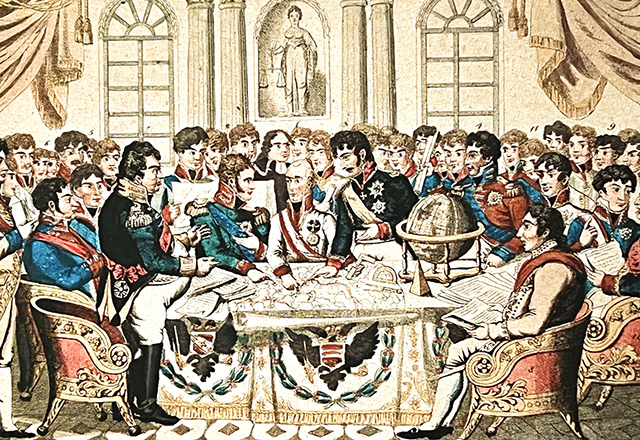
I never did particularly well in history. I probably owe an apology to my 11th-grade AP European History teacher, because there are entire centuries I can barely account for. Ask me about the Congress of Vienna, and there’s a good chance I’ll suddenly develop an interest in changing the subject.
And yet, somehow, I chose a profession obsessed with history.
When a patient comes into the hospital, one of the first things we ask about is the history of their present illness. Then their past medical history, family history, social history and surgical history. Within 20 minutes of meeting someone, we’re trying to understand not just what’s happening to them now, but everything that came before it.
Medical school was built on the same premise. So much of learning medicine is learning how we came to know what we know, with every discovery resting on something that came before it. The smartwatch that now detects atrial fibrillation traces its lineage back to Willem Einthoven and the early electrocardiogram, when recording the heart’s electrical activity required a machine so large that patients placed their limbs into buckets of salt water. Today, those same electrical signals can be picked up by something sitting on your wrist.
That’s medicine to me: an accumulation of ideas, experiments, mistakes, discoveries and people. Science moves forward, but it never starts from zero. Neither do our patients.
That idea came into sharper focus during Foundations of Clinical Excellence, one of the first formal courses of intern year at Bayview. We had the privilege of hearing Dr. Erica Johnson speak about structural vulnerability. The course teaches many of the things that can get lost in residency: physical diagnosis, relationship-centered care, clinical reasoning, seeing the patient beyond the problem list. Her lecture pushed that idea further, arguing that to understand our patients, we also have to understand the communities and systems they move through.
She introduced us to a paper that has stayed with me, Structural Vulnerability: Operationalizing the Concept to Address Health Disparities in Clinical Care, by Philippe Bourgois and colleagues. The authors challenge the way we’re taught to take a social history. Too often, it becomes a list of behaviors—smoking, alcohol, drugs, diet—without asking what shaped those behaviors in the first place.
That reframing changes how familiar chart phrases read:
- Patient missed last five PCP appointments. Did they have transportation?
- Patient noncompliant with anticoagulation. Could they afford the medication?
- Diet high in salt and fat. What food was actually available to them?
- Last ED visit two weeks ago. What other options did they have?
Structural vulnerability means looking beyond the individual to the social, economic, legal and institutional forces that shape health and constrain choice. Bourgois and colleagues didn’t stop at describing the problem. They developed a Structural Vulnerability Assessment Tool to bring those forces into the clinical encounter itself.
As they write, “Awareness of structural vulnerability is not enough.”
That line stuck with me. The point isn’t simply to recognize disparities, but rather to change how we understand the patient in front of us — and, when possible, what we do next.
A day later, our class visited Turner Station, not far from Bayview. I had known the name Henrietta Lacks before I walked through the neighborhood where she lived. But seeing Turner Station made the story feel different. It placed something I had learned as medical history into an actual community, with streets, homes, churches, industry and generations of families whose lives were shaped by Baltimore’s history.
My patient’s history didn’t begin when they entered the hospital. They were shaped long before that — by where they grew up, what work was available, what neighborhoods they could live in, what environmental exposures surrounded them and what their community’s relationship with medical institutions had been.
Walking through Turner Station made me understand Baltimore differently, and in turn made me understand some of my patients differently. The neighborhood carries the history of segregation, Black workers at Bethlehem Steel, economic opportunity and loss, environmental change, and a community that has worked hard to preserve its identity.
Those histories aren’t just background. They help explain the conditions into which people are born and the choices available to them decades later.
That’s what structural vulnerability began to mean to me in practice. The “social history” in a note is only the most recent chapter.
Training at Bayview has made me increasingly aware that learning medicine here also means learning Baltimore. I’m grateful to train in a place where the history surrounding the hospital is still visible, and to communities like Turner Station that have preserved it well enough for us to encounter it directly.
Maybe that’s another form of history-taking: understanding not only what happened to the patient, but what happened before them.
Which, unfortunately for my 11th-grade self, means my AP European History teacher may have been right all along.
It turns out history does matter. I just needed someone to replace the Congress of Vienna with an ECG machine and a few buckets of salt water.
Related content
Want to read more from the Johns Hopkins School of Medicine? Subscribe to the Biomedical Odyssey blog and receive new posts directly in your inbox.