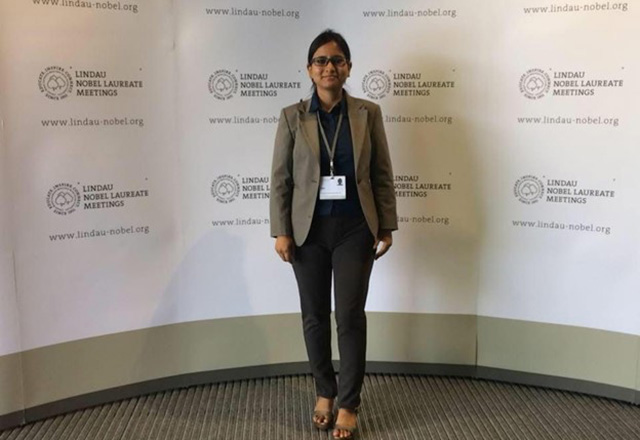
The Lindau Nobel Laureate Meeting brings together Nobel Laureates and early-career researchers from around the world for a week of scientific exchange and open dialogue. What distinguishes Lindau from traditional conferences is its emphasis on conversation rather than presentation alone. Through scientific lectures, Agora Talks and small-group discussions, Nobel laureates spoke candidly about their scientific journeys, including failure, uncertainty and persistence: Topics that are often underrepresented in formal scientific training.
Beyond the scientific talks, the experience centered on open conversations about the realities of research careers. Discussions about navigating setbacks, maintaining curiosity through uncertainty and sustaining motivation over long scientific timelines were particularly resonant. The opportunity to engage with Nobel laureates and peers from around the world left me inspired, grounded and motivated to approach science as a collaborative and global effort rather than an isolated pursuit.
I was selected to attend the 68th Lindau Nobel Laureate Meeting through a competitive international selection process that recognizes promising young scientists based on academic achievement and research potential. time, these conversations were especially impactful. Hearing accomplished scientists reflect openly on setbacks reframed how I thought about progress in research. Rather than viewing challenges as personal shortcomings, Lindau emphasized that uncertainty, revision and resilience are integral parts of the scientific process, shared across generations, disciplines and career stages.
Equally valuable were the interactions with fellow young scientists from diverse countries and research backgrounds. The exchange of ideas, perspectives and experiences highlighted how scientific questions are shaped by cultural, institutional and societal contexts. Lindau fostered a strong sense of belonging to a broader scientific community — one that extends far beyond individual laboratories or institutions and is strengthened by collaboration, empathy and mutual respect.
The meeting also reinforced the importance of communication in science. Conversations at Lindau emphasized not only the responsibility scientists have to advance knowledge, but also to communicate their work thoughtfully to broader audiences and to one another. This perspective encouraged me to think more intentionally about how research is shared, taught and translated beyond the bench.
Returning to my Ph.D. research, I carried with me a renewed sense of purpose and confidence. The experience strengthened my motivation to approach science with a broader perspective, to value mentorship and dialogue, and to remain engaged with the scientific community beyond my immediate field. This recognition was not only a personal milestone, but also a reflection of the training environment and mentorship that supported my development as a researcher.
Opportunities like the Lindau Nobel Laureate Meeting demonstrate how investment in early-career researchers can shape not only individual trajectories, but also the future culture of science itself. By creating spaces where young scientists can learn, connect and reflect, initiatives like Lindau help cultivate a scientific community that values openness, resilience and collaboration, which are qualities essential for addressing the complex challenges ahead.
Related Content
Want to read more from the Johns Hopkins School of Medicine? Subscribe to the Biomedical Odyssey blog and receive new posts directly in your inbox.