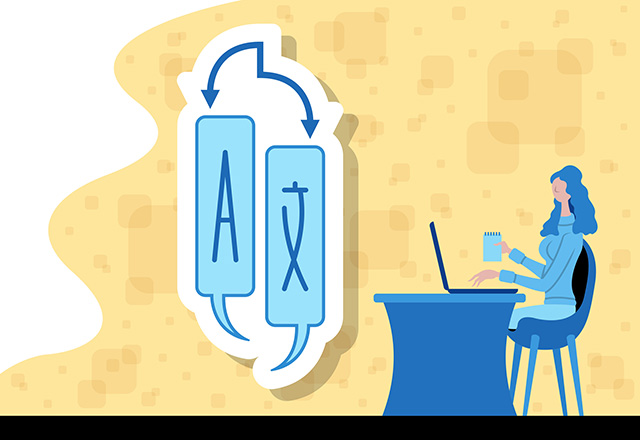
I was confident in my English skills, but when I moved from Mexico to the US four years ago to work in biomedical research, I was quickly humbled by the challenges of navigating daily life in a new language.
Simple tasks such as writing emails, making phone calls, or filling out paperwork suddenly took twice as long to complete as they had in my native language. Even the grocery store felt overwhelming: relearning ounces and pounds while choosing between endless milk fat percentages. At work, I was both annoyed and fascinated by the heavy use of acronyms. I loved how they made communication concise and efficient, but hated how they added an extra layer of difficulty for those of us still learning the language. I quickly realized that being funny in a foreign language is hard, not only because timing is everything in comedy and it’s tough to land a punchline when you’re stumbling over words, but also because so much of my humor is tied to cultural references that only Mexicans would understand.
Months into living in the US, the effort of adjusting to a new language began to wear on me. I remember the frustration of prepping for my first presentation in English. I scripted every word beneath each slide and relied on reading my notes during the presentation just to get through it. I used to enjoy presenting; I was good at it, and I knew it. But what had once been my greatest strength now felt like my biggest weakness. I felt as though pieces of my personality were slipping away, leaving me less capable, less funny, and far less confident.
Over time, I realized this wasn’t just discouraging, it was exhausting. Living, thinking, and working in another language required a constant level of mental effort. On one particularly long day, already worn out, I was dreading staying late to learn a new protocol with a colleague from Bolivia, Sara. But we ended up doing the training in Spanish, and I was amazed by how quickly I picked it up, chatting easily and even sharing a few jokes. In that moment, it became clear that my ability had never disappeared; it had simply been buried under the weight of another language. At the end of the training, before leaving for a new job the next day, Sara gave me a goodbye hug. It wasn’t until that moment we shared a hug that I realized how much I needed it. After months of overwhelming emotions and self-doubt, that small gesture brought me a strong and unexpected sense of comfort. Apapacho, I thought—that’s the word for it. But what’s the word in English?
There is no direct English translation for the word apapacho. In fact, there is no direct translation for this word in any other language. It belongs to a category known as Untranslatable Words. One of the first things you notice when moving to a new country is the amount of words that cannot be directly translated from your native language to the local one, and vice versa. You soon recognize how deeply tied some words are to cultural context. Even with an equivalent translation, the meaning often feels incomplete. To me, apapacho represents more than just a hug; it’s the warmth and love of being comforted after falling as a child, cared for when you’re sick, or held close in your grandmother’s arms.
The apapacho I received from Sara that day made me reflect on the complexities of language. Sometimes the struggle to find a direct translation reveals something powerful: different cultures notice, value, and perceive reality in different ways. Language, I came to realize, is not just a tool for communication; it is a way of making sense of reality. And in science, that is precisely what we do: we observe, we interpret, and we try to give meaning to the natural world. Nobel laureate Carolyn Bertozzi has spoken about how her laboratory benefits from recruiting students from around the world, international students who bring distinct ways of thinking, questioning, and approaching problems. Biology offers a fitting metaphor. Endosymbiotic processes, where different organisms come together to form something more capable than either could be alone, are responsible for some of the most important evolutionary leaps. Scientific communities work the same way. When we bring together diverse voices, cultures, and languages, we generate ideas that would not exist in isolation.
By studying how language shapes thought, I began to release the frustration and shame I had attached to my struggles. I stopped being so hard on myself and chose to see my cultural and linguistic background as an advantage rather than a limitation. I no longer see my accent, my pauses, or my untranslatable words as losses. They are evidence of another way of perceiving reality. And in research, where progress depends on imagining what does not yet exist, those differences are not a weakness, they are a strength.
Related Content
- All At Once
- A New Student’s Guide to Baltimore Cafes
- Best Authentic Chinese Food in Baltimore: Where to Go and What to Order
Want to read more from the Johns Hopkins School of Medicine? Subscribe to the Biomedical Odyssey blog and receive new posts directly in your inbox.