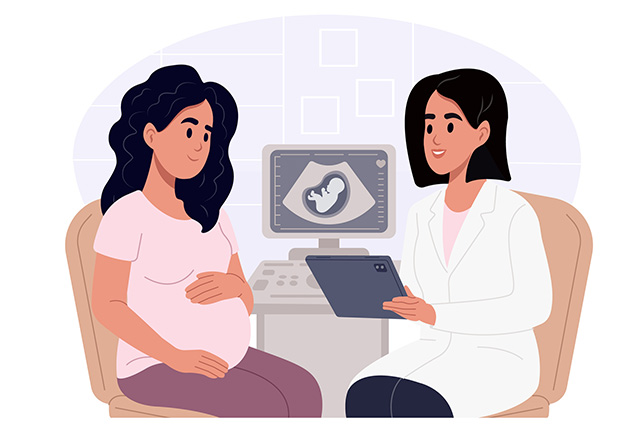
Your first argument with your mother was over housing. For months you lived together in relative peace, but you just rubbed her the wrong way from time to time. Plus, she didn’t expect that you would take up this much space. It happened gradually, over a thousand small arguments where you pushed and pushed her, until one day when you got on her last nerve. So, she did what any mother would do: She started her uterine contractions and gave birth to you.[1] Creative liberties aside, this metaphor turns out to capture a real biological principle behind childbirth. In a recent study published in Science, researchers found that the fetus “pushing” on the womb throughout pregnancy is sensed by the mother’s body, and this sensation plays an essential role in regulating the onset and progression of labor. The stretch of the uterus is sensed by specialized receptors called PIEZOs. Once activated, PIEZOs lead the uterus cells to produce the cellular machinery required for strong, coordinated labor contractions.
PIEZOs are receptors that detect stretches in a cell’s membrane caused by mechanical force, most famous for being responsible for our sense of fine touch. Their discovery by Ardem Patapoutian’s group won him the Nobel Prize in 2021. Recently, the same group found these PIEZO receptors in the reproductive organs of female mice — in uterus muscle cells and the nerves that communicate with the birth canal. The researchers then genetically deleted the receptors from these organs to see how it would affect birth. The mice lacking PIEZOs showed weaker contractions and prolonged labor, despite having otherwise normal pregnancies. Some failed to deliver babies at all. Looking more closely, the researchers found that in mice lacking PIEZOs, uterus cells had fewer numbers of structures called “gap junctions” — bridges between cells that, in muscles, are crucial for synchronized movement. This explained why the mice lacking PIEZOs had weaker labor contractions: When the body couldn’t detect the increasing tension in the uterus as the baby grew, it failed to produce the appropriate cellular machinery to support the birth process.
For decades, scientists had known that childbirth is influenced by hormones — exogenous oxytocin is even used to trigger labor. However, whether sensory feedback from the uterus itself played any role in childbirth remained unclear. The study was among the first to show that the body actively senses uterine stretch, and that this sensation is essential for strong labor contractions. The findings also have potential clinical applications. In theory, drugs that dampen PIEZO activity might one day help delay labor in cases where premature birth is expected. Conversely, drugs that activate PIEZO channels may be able to help initiate or strengthen contractions to speed up labor induction. More needs to be understood about the workings of these receptors in the uterus — for example, how PIEZOs can lead uterus cells to produce more gap junctions — before these clinical efforts are underway. But one lesson is clear: Sometimes it’s better to acknowledge the tension and work through it, rather than sweep it under the rug.
[1] Be advised that this doesn’t apply if you were a C-section.
Related Content
- Becoming First-Time Parents at Johns Hopkins
- You Are NOT the Father – How Parthenogenesis Can Explain the Miraculous Pregnancy of a Lone Stingray
Want to read more from the Johns Hopkins School of Medicine? Subscribe to the Biomedical Odyssey blog and receive new posts directly in your inbox.