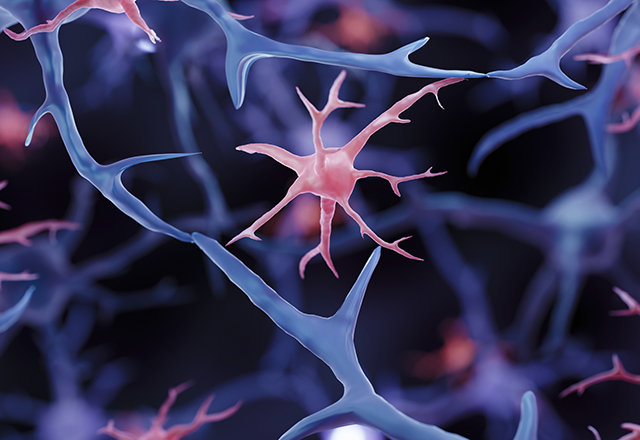
What if neurons aren’t the only cells that create thoughts? Research into glia has complicated the neuron-focused story.
Neurons are known as the brain cells that “fire.” A stereotypical neuron receives molecules called neurotransmitters, combines those signals, and then sends a fast signal (action potential) down its axon, which makes calcium flood into the cell, releasing neurotransmitters to the next neuron.
The term “glia” encompasses most cells in the nervous system that aren’t neurons. Broadly, oligodendrocytes (Schwann cells in the peripheral nervous system) wrap fatty insulating layers around axons to speed up action potentials, microglia serve as the brain’s immune system, and astrocytes recycle neurotransmitters, among other functions.
What glia aren’t known to do is fire action potentials; i.e., spikes.
“[I]t’s hard to directly measure the direct output of astrocyte activation at the presumed level of their effect in vivo; i.e., astrocyte processes and synapses. It’s not like neurons, where you can get (relatively easily) a direct readout of one neuron’s output (spiking), and record downstream neurons that receive that output,” said Julia Pai, a postdoc in Ilya Monosov’s lab at Johns Hopkins.
However, astrocytes do experience calcium waves [1]. Imaging technologies have even enabled researchers to record astrocyte and neuronal calcium activity simultaneously by genetically encoding different fluorescent proteins for calcium in astrocytes vs. neurons and scanning with differently colored lasers. A 2019 study found that astrocytes participate in a zebrafish brain circuit that helps the fish decide whether to give up when struggling against a current [2]. The fish stopped giving up when treated with ketamine, a fast-acting antidepressant [3]. This led to further work in mice [4] and zebrafish [5,6]. (Disclaimer: I collaborate with the Ahrens lab.)
Pai saw both the questions and the challenges of studying astrocytes as her inspiration for getting into the research as a Ph.D. student.
“I think a lot of the physiological effects on synaptic plasticity in the literature seem to be converging on astrocytes mediating synaptic depression, but under what contexts this happens in vivo, if or how this happens in vivo, if or how astrocyte responses to different neuromodulators have different effects on the circuit, etc., are all poorly understood,” Pai said. (Synaptic depression: weakening of signaling between neurons.)
At Johns Hopkins Translational Neuroengineering Technologies Network conference on May 4, 2026, Pai shared findings from her preprint, “Ventral striatal astrocytes contribute to reinforcement learning” [7], which suggest that astrocytes in the ventral striatum play a role in reward-driven choices in mice. A combination of experimental work and computational modeling suggests they may do this by reducing the noisiness of the reward prediction error signal by regulating excitation-inhibition balance and/or sharing signals across neurons. Mechanisms of astrocytes’ (and all glia’s) roles in computation across the brain remain open questions.
“Whether [astrocytes’ influence on behavior is] only through setting synaptic strength, or spatiotemporal smoothing of neural variability, or both, or [whether] this differs across brain areas or neuromodulators still needs to be explicitly tested,” Pai said.
References
[1] Bazargani, Narges, and David Attwell. 2016. “Astrocyte Calcium Signaling: The Third Wave.” Nature Neuroscience 2016 19:2 19 (2): 182–89. https://doi.org/10.1038/nn.4201.
[2] Mu, Yu, Davis v. Bennett, Mikail Rubinov, et al. 2019. “Glia Accumulate Evidence That Actions Are Futile and Suppress Unsuccessful Behavior.” Cell 178 (1): 27-43.e19. https://doi.org/10.1016/j.cell.2019.05.050.
[3] Duque, Marc, Alex B. Chen, Eric Hsu, et al. 2025. “Ketamine Induces Plasticity in a Norepinephrine-Astroglial Circuit to Promote Behavioral Perseverance.” Neuron 113 (3): 426-443.e5. https://doi.org/10.1016/J.NEURON.2024.11.011.
[4] Hsu, Eric. 2024. “NOREPINEPHRINE-MEDIATED ASTROCYTE CALCIUM SIGNALING IN FREELY MOVING MICE.” https://jscholarship.library.jhu.edu/handle/1774.2/70614.
[5] Chen, Alex B., Marc Duque, Altyn Rymbek, et al. 2025. “Norepinephrine Changes Behavioral State through Astroglial Purinergic Signaling.” Science 388 (6748): 769–75. https://doi.org/10.1126/SCIENCE.ADQ5233;PAGE:STRING:ARTICLE/CHAPTER.
[6] Lim, Jing-Xuan, Ziqiang Wei, Sujatha Narayan, et al. 2026. “Astrocyte-Induced Internal State Transitions Reshape Brainwide Sensory, Integrative, and Motor Computations.” bioRxiv, February 5, 2026.02.05.704034. https://doi.org/10.64898/2026.02.05.704034.
[7] Pai, Julia, Fatih Sogukpinar, Kei Ogasawara, et al. 2026. “Ventral Striatal Astrocytes Contribute to Reinforcement Learning.” bioRxiv, June 29, 2025.10.20.683205. https://doi.org/10.1101/2025.10.20.683205.
Related content
Want to read more from the Johns Hopkins School of Medicine? Subscribe to the Biomedical Odyssey blog and receive new posts directly in your inbox.