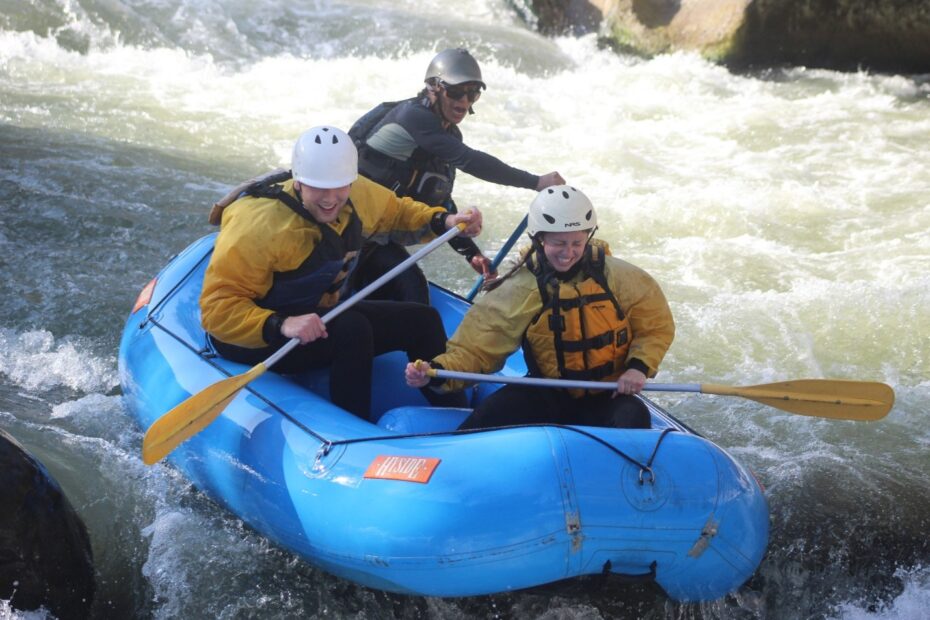
Blending adventure with sublime natural beauty, whitewater rafting is one of my favorite outdoor activities. Recently, my wife and I traveled to Ontario to raft the powerful, granite-stained waters of the wild Ottawa River. Unlike the continuous swift water of many Eastern U.S. waterways, the Ottawa flows smoothly and calmly in large open pockets, almost like a lake, before funneling into narrow boulder-lined canyons with thunderous rapids. Drifting by evergreen banks, rocky outcroppings and wild thickets with no buildings or infrastructure in sight, rafting the Ottawa was a truly sublime experience. Cruising home at 36,000 feet, I reflected on my journey, drawing one startling conclusion — physicians are a lot like rafting guides.
Barreling down class 4-5 rapids, guides rely much more on the cooperation of the paddlers than in more tranquil class 1-2 water. Usually, the raft holds a few people, working in tandem, led by an experienced guide calling out paddling commands to navigate the rapids in the safest manner. Relying on the paddlers for power, the guide steers and coaches the team through the challenging rapids. Each rapid has its own unique set of dangers, pitfalls and surprises. Due to storms, rains and erosion, river courses change daily. You truly never know what awaits you. It is the guide’s duty to prep the team on each rapid, what course to take, where to go if you flip, how to navigate the rapid if you fall out, and how to rescue someone overboard. The guide instructs how to approach the rapid, when to paddle and what maneuver to use, all in hopes of navigating safely.
Similarly, a physician acts as a guide, so to speak, for the patient and family. Studying for years and learning from experience, the physician likely knows more about the patient’s illness and upcoming treatment course than the patient. Tasked with using this knowledge to help the patient navigate the medical system, the physician must explain the upcoming illness course, approaches to potential complications, possible treatment strategies, and directions to take for the patient’s desired treatment goal.
The physician guides the patient through the raging waters of disease, directing the course through chaos. However, like a river guide, the physician relies on the patient as well. The physician can point toward the seemingly right direction, but the patient and family ultimately hold the paddles, choosing which route to take.
Even when the patient chooses the suggested route, unexpected boulders and powerful waves arise. Despite quality therapy, the cancer may return. Despite antibiotics and IV fluids, blood pressure may continue to drop. The river of life changes daily, and no one — doctor, patient or family — truly knows its course. Patient and physician can perfectly approach an illness, but the illness can still overcome the patient. Like rafting, medicine is an unpredictable team activity. Physicians and patients in the raft, the river of life thunders forward with rapids in the distance. We float or flip together.
Related Content
Want to read more from the Johns Hopkins School of Medicine? Subscribe to the Biomedical Odyssey blog and receive new posts directly in your inbox.